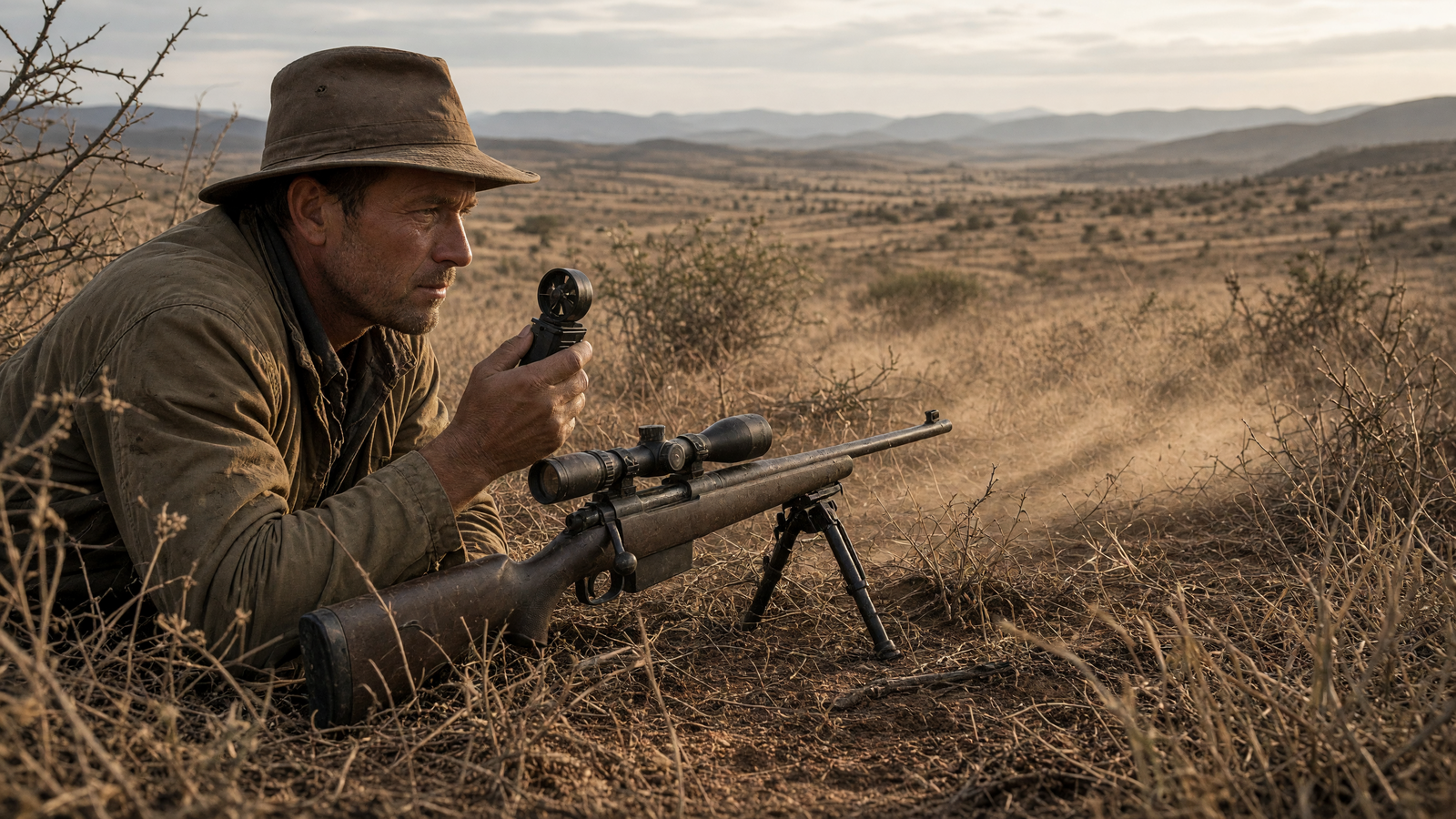
Reading wind patterns is one of the most decisive skills a hunter can develop for long-range shots across southern Africa. Whether you are glassing gemsbok on the open plains of the Kalahari, settling in for a kudu in the Limpopo bushveld, or lining up on springbok in the Karoo, wind will push your bullet off course far more than most shooters expect once distances stretch past 300 yards. Ethical one-shot kills on plains game demand that you understand not only the breeze at your shoulder but the full column of air between you and the animal.
In the arid expanses of Namibia and the Northern Cape, steady afternoon winds are common and often stronger than they first appear. Begin by watching vegetation at several ranges. Dry grass and low scrub in the Kalahari react quickly to even a light breeze, while mopane leaves in the Lowveld or bushwillow in Zimbabwe’s Zambezi valley give subtler clues. A handful of loose sand or fine dust flicked into the air remains one of the oldest and most reliable indicators; watch how it drifts and at what height it begins to shear. Wind flags set out by professional outfitters on established ranges are useful, yet the real hunting world rarely offers them, so train yourself to read natural signs first.
Mirage seen through a quality riflescope is equally telling. On hot Highveld mornings or across the sun-baked flats of Botswana’s Central Kalahari, heat shimmer reveals both speed and direction. When the mirage boils straight up, the wind is light or temporarily calm at that distance. When it runs hard left or right, you are looking at a meaningful crosswind. Learn to distinguish the slow, rolling mirage of a 5 mph drift from the flat, racing shimmer of 15 mph or more. These observations matter enormously when the target is a wary eland or a trophy sable standing on a distant ridge.
Wind speed estimation becomes second nature with practice. A light breeze of 3 to 5 mph barely stirs leaves and will move a typical .300 Winchester Magnum or .375 H&H bullet only modestly inside 400 yards. Moderate winds of 6 to 12 mph set leaves rustling and small branches nodding; this is the everyday condition across much of the Eastern Cape and Free State winter hunting season and will produce noticeable drift that must be held off. Strong winds of 13 to 20 mph sway small trees, raise dust devils on open pans, and can shove a bullet several feet at 500 yards. In the Namib and parts of the Kalahari, afternoon winds regularly reach these strengths, so plan stalks and shooting positions with that reality in mind.
Direction is best described with the classic clock method. Imagine the animal at the centre of a clock face and yourself at 6 o’clock. A full-value wind from 3 or 9 o’clock demands the largest correction, while a wind from 1 or 11 o’clock is roughly half value. Many southern African professional hunters and trackers already use this language on the radio or in whispered conversation, so it integrates smoothly into guided hunts for buffalo, nyala or wildebeest. Always remember that the wind at the muzzle, midway, and at the target can differ. Terrain features create wind shadows and channels: a dry riverbed in the Limpopo may be calm at the bottom while the ridge above is blowing hard; a stand of acacias can deflect air around a warthog feeding in the open; rocky kopjes in Zimbabwe or Zambia funnel gusts in unpredictable ways.
Compensation starts with solid ballistic data for your load. Modern apps and custom charts that account for true ballistic coefficient, altitude and temperature are widely used by serious hunters preparing for South African or Namibian safaris. Enter the expected wind and let the software give you a starting hold, then refine it with what you see on the ground. Do not rely solely on the device. Practice at the range under real wind, preferably on steel plates set at 400, 500 and 600 yards, so you build a mental library of holds for your rifle. When a big kudu bull steps out at distance, you will already know whether a half-mil or full-mil hold into the wind is required.
Thermal activity changes throughout the day and is especially pronounced in mountainous or broken country such as the Waterberg, the Drakensberg foothills or the rugged terrain of eastern Zimbabwe. Early morning often brings cool air sliding downhill; by mid-morning the flow reverses as slopes heat. In the desert fringes of Namibia and the Northern Cape these shifts can be abrupt. Time your stalks accordingly and re-evaluate wind after every major move. A shooting partner or PH calling wind while you settle behind the rifle is invaluable; many experienced teams in Botswana and South Africa use exactly this system on long-range plains-game hunts.
Terrain-specific habits repay study. In the open Karoo and Kalahari the wind is frequently consistent but strong, so favour lower shooting positions that keep the bullet in denser air for less time and watch for dust that betrays gusts. In thicker Limpopo or Lowveld bush the challenge is often spotting the animal through gaps while reading swirling air around thickets; shorter practical ranges are common, yet a sudden lane may still offer a 350-yard opportunity on impala or bushbuck. Along the Zambezi valley and in parts of Mozambique, riverine humidity and daily thermal cycles add further variables. Always confirm local hunting-season wind patterns with your outfitter; winter cold fronts sweeping across the Highveld and Free State can bring days of persistent crosswinds that test every calculation.
Regulations and ethics reinforce the need for competence. South African provinces, Namibia, Botswana, Zimbabwe, Zambia and Mozambique all require that hunters take only shots they can place with certainty. Wounding loss on long-range attempts is unacceptable, both for the animal and for the reputation of the hunting industry. Master wind reading so that when the moment comes for a gemsbok on a distant dune or a mature kudu across a valley, the shot is clean. Carry a compact notebook or use your phone to log observed wind, estimated speed, actual drift and result after every range session or hunt; patterns emerge quickly and confidence follows.
Finally, accept that mastery is gradual. Spend time simply watching wind move across the biomes you hunt. Sit on a ridge in the Eastern Cape and track how air behaves from sunrise to late afternoon. Glass springbok herds while noting every shift in the grass. The same disciplined observation that makes a good tracker also makes a deadly long-range shooter. Combine that field craft with verified ballistics, honest practice and respect for the game, and wind ceases to be an enemy. It becomes simply another element you read as fluently as spoor or body language, ensuring clean, ethical harvests across the diverse hunting grounds of southern Africa.