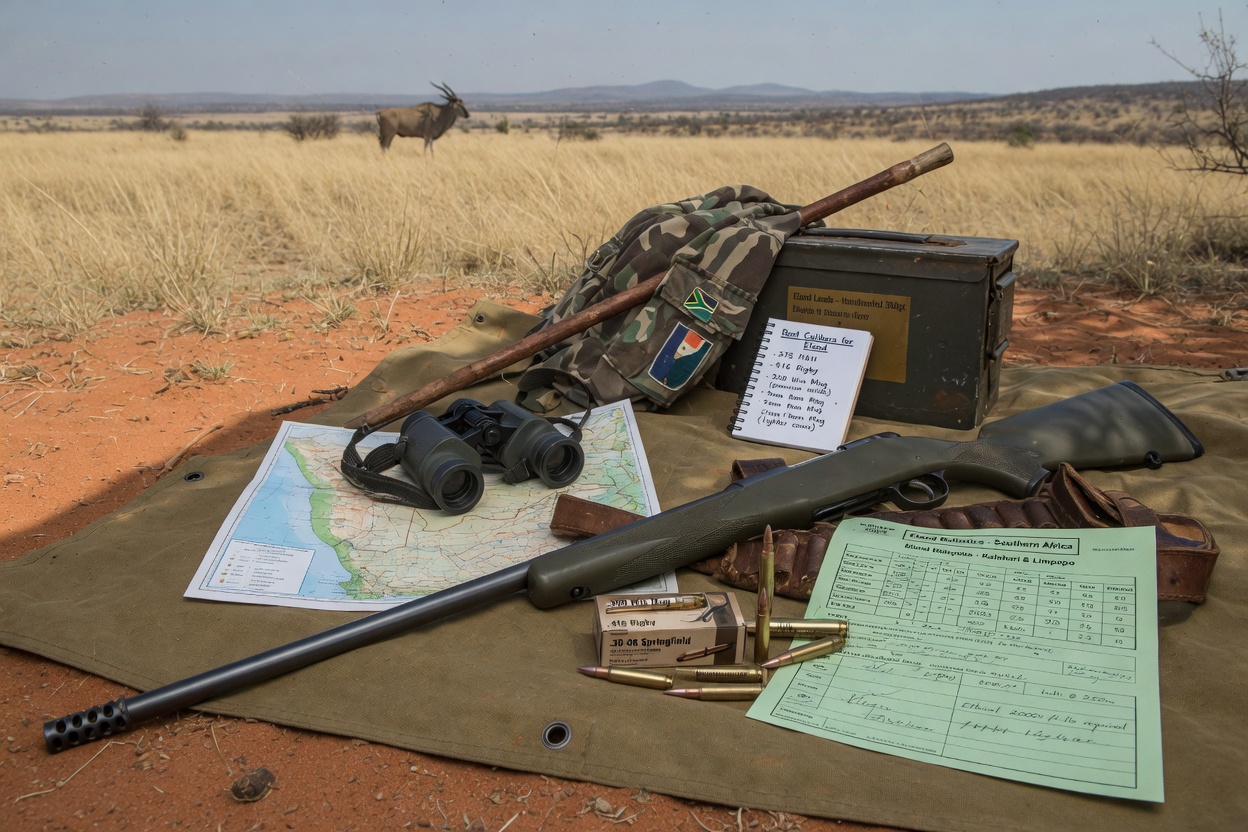
Hunting the Cape eland in Southern Africa stands as one of the most rewarding pursuits for any serious hunter. As the largest antelope on the planet, a mature bull can tip the scales at over 2,000 pounds, with a thick hide, dense muscle, and heavy bone structure that demand respect from both hunter and rifle. Choosing the right caliber is not just about knocking down a big animal. It is about ensuring a quick, ethical kill that honors the animal and supports the conservation efforts funded by legal hunting across South Africa, Namibia, Botswana, and Zimbabwe.
Many first-time visitors to the region underestimate the eland. These animals look almost cattle-like from a distance, but they are incredibly tough and can cover ground quickly even when wounded. Poor shot placement or inadequate penetration turns a dream hunt into a long, difficult tracking job that stresses both the hunter and the professional hunter guiding you. The right cartridge, paired with premium bullets and practiced shooting, makes all the difference.
Understanding the animal itself helps explain why caliber choice matters so much. Eland inhabit open savanna, mopane woodland, and mountainous terrain. They often present quartering shots or require shooting through light brush. A bullet must retain enough energy to reach the vitals after punching through heavy shoulder or the distinctive dewlap. Studies from professional hunting associations and ballistic testing consistently show that impact energy above 3,000 foot-pounds combined with deep, straight-line penetration produces the most reliable results on animals of this size.
Legal requirements vary by country and even by province or concession. South Africa generally treats eland as plains game with no strict minimum caliber, though many operators prefer clients arrive with at least a .300 Winchester Magnum. Namibia and Botswana often recommend or require .375 H&H Magnum class rifles for larger species including eland. Zimbabwe has historically set higher standards for certain areas. Always confirm current regulations with your outfitter well in advance, as rules can change and some private reserves impose their own ethical minimums. Ignoring these can result in a cancelled hunt or, worse, an unethical situation in the field.
When it comes to actual recommendations, experienced professional hunters across Southern Africa consistently point to a handful of proven cartridges. The .375 H&H Magnum remains the gold standard for many. It delivers roughly 4,300 foot-pounds of energy with 300-grain bullets, offers manageable recoil in a properly fitted rifle, and has a long track record of cleanly taking eland at typical hunting distances of 50 to 250 yards. Modern loads using premium bullets like the Barnes TSX or Swift A-Frame provide excellent weight retention and expansion.
Stepping up, the .416 Rigby and .416 Remington Magnum give even more authority. These cartridges push 400-grain bullets at velocities that produce well over 5,000 foot-pounds. They shine when shots might involve heavier bone or when hunting in thicker cover. Recoil is noticeably sharper, so a well-designed stock and plenty of practice become essential. Many hunters who regularly pursue eland and other large plains game keep a .416 as their go-to African rifle.
The .458 Winchester Magnum and .458 Lott occupy the next tier. These are serious stopping cartridges originally designed for dangerous game, yet they perform beautifully on eland when loaded with appropriate expanding bullets rather than solids. The extra power provides a margin of error that some hunters appreciate, especially on older, heavier bulls. Recoil is stout, so these rifles suit experienced shooters who have trained extensively.
Lighter options such as the .300 Winchester Magnum, .338 Winchester Magnum, and even the newer .300 PRC can work in skilled hands with perfect shot placement and premium 180- to 225-grain bullets. Many successful eland have been taken with these cartridges. However, they leave less room for error. A slightly off-angle shot or a bullet that fails to perform can lead to problems. If you choose this route, select the heaviest, toughest bullets available and limit yourself to broadside or slightly quartering presentations inside 200 yards.
Bullet construction matters as much as caliber. Avoid cheap cup-and-core ammunition. Controlled-expansion designs that hold together while still mushrooming reliably give the best combination of penetration and energy transfer. Solids are rarely needed on eland unless you specifically anticipate a raking shot through heavy vegetation. Most professional hunters prefer a bonded or monolithic expanding bullet for this species.
Practical preparation separates successful hunts from frustrating ones. Sight your rifle in at the range you expect to shoot, typically 100 to 200 yards, and confirm zero after travel. Practice from field positions including sitting, kneeling, and off shooting sticks, because African hunts rarely offer benchrest opportunities. Recoil management through proper technique and a good recoil pad prevents flinching that ruins accuracy. Discuss your rifle and ammunition with your professional hunter before the hunt begins so adjustments can be made if needed.
Conservation remains central to every ethical eland hunt. Legal, regulated hunting generates significant revenue that funds anti-poaching units, habitat protection, and community programs throughout Southern Africa. By choosing an adequate caliber and making a clean kill, you contribute directly to the future of these magnificent animals. Outfitters who follow sustainable quotas help maintain healthy populations while providing local employment.
The best caliber is ultimately the one you can shoot accurately under field conditions while still delivering sufficient power. Many hunters find the .375 H&H Magnum strikes the ideal balance of effectiveness, availability of ammunition, and shootability. Others prefer the extra authority of a .416. Whatever you choose, invest time in practice, select quality ammunition, and listen to your professional hunter’s advice once you are on the ground.
Southern Africa offers some of the finest eland hunting on earth, from the Kalahari sands to the escarpments of the Eastern Cape. With the right rifle in your hands and a commitment to ethical standards, you will create memories that last a lifetime while supporting the wildlife that makes these hunts possible. Start planning your trip by speaking with experienced outfitters who understand both the animals and the equipment needed to hunt them properly. Your next great African adventure awaits.