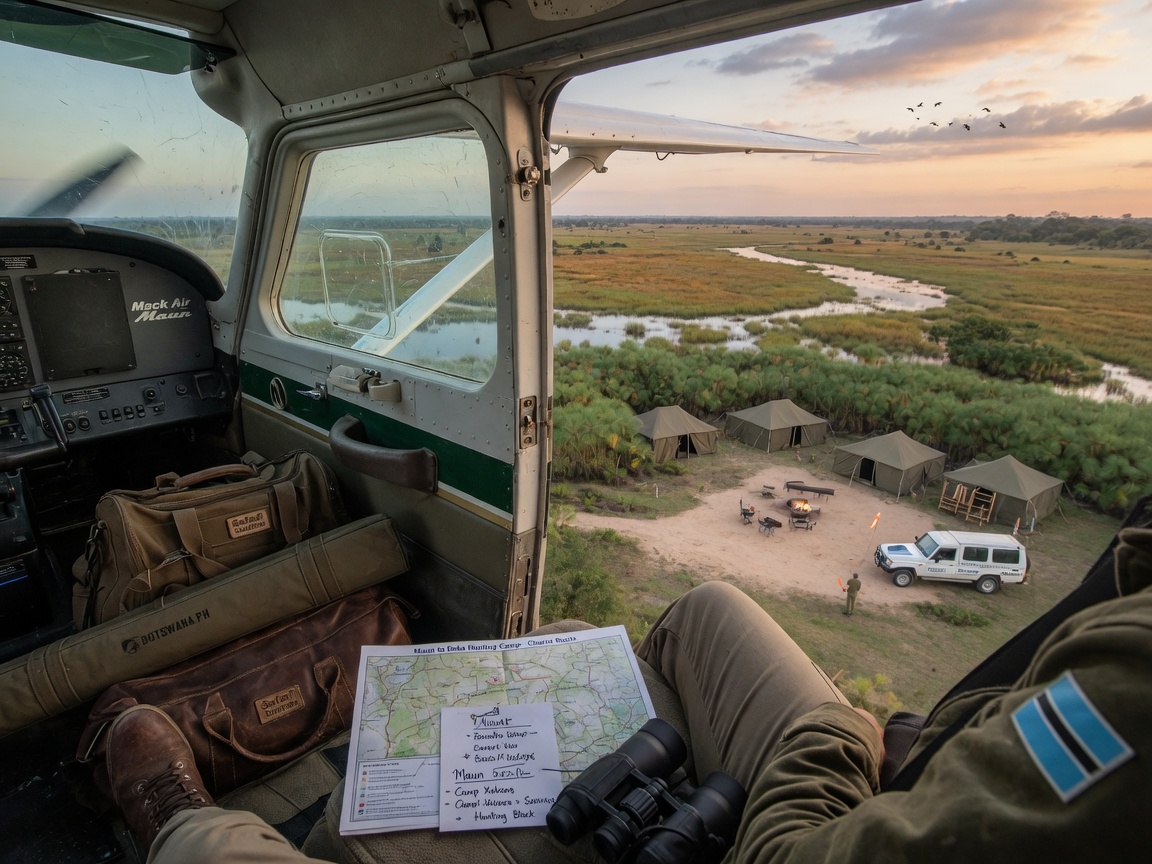
Imagine landing in Maun after your international flight, the heat of the Botswana sun hitting you as you step onto the tarmac at Maun International Airport. This dusty, vibrant town on the edge of the Okavango Delta is more than just a transit point. It is the launchpad for some of the most remote and rewarding hunting adventures in Africa. From here, a short charter flight takes you over endless floodplains, mopane woodlands, or the red sands of the Kalahari straight to a hunting camp that few people will ever see. For hunters targeting buffalo, elephant, plains game, or leopard in Botswana's concessions, these flights are not a luxury. They are the only practical way in.
Maun has long served as the tourism capital of northern Botswana. The airport handles a mix of scheduled commercial flights and a busy network of light aircraft that fan out daily to safari lodges and hunting camps. Many of the best hunting areas sit in community-managed concessions far from any all-weather road. During the rainy season those tracks turn to mud. Even in the dry months the distances make a four-by-four transfer a full-day ordeal that eats into precious hunting time. A 45-minute flight replaces that grind and drops you, rifles and all, almost at the campfire.
Charter options fall into two broad categories. Shared or scheduled charters run regular routes between Maun and popular airstrips when there is enough demand. These work well if your dates line up and you do not mind sharing the cabin with other guests heading to nearby camps. Private charters give you the whole aircraft. You set the departure time, you choose the routing, and you land exactly where your professional hunter is waiting. Most hunters on a dedicated safari prefer the private option for flexibility and privacy, especially when transporting firearms.
The aircraft themselves are typically single-engine Cessnas, the workhorses of the African bush. A Cessna 206 carries four or five passengers plus a modest load of gear. The larger Cessna Grand Caravan or similar turbine aircraft can take eight to twelve people and more luggage, which matters when several hunters and their trackers are travelling together. Twin-engine planes appear on longer legs or when operators want extra safety margin over remote country. All of them are flown by pilots who know every dirt strip, every seasonal flood, and every herd of elephant that likes to wander onto the runway.
Reputable operators based in Maun include established names that have served both photographic and hunting clients for decades. They maintain high safety standards, carry proper insurance, and work closely with the Department of Wildlife and National Parks. Your outfitter will normally handle the booking, but it pays to confirm the company, the aircraft type, and the exact weight limits well in advance. Recent years have seen a gradual shift toward more fuel-efficient turbines and better avionics, improvements that make the flights quieter and more reliable even in the heat of October.
Flight times are short. Camps in the eastern Okavango or NG concessions are often only 20 to 40 minutes away. Destinations deeper in the Kalahari or toward the Namibian border can take 70 to 90 minutes. The views alone are worth the ticket. You fly low enough to spot giraffe, zebra, and sometimes the dark shapes of buffalo or elephant moving through the trees. Landing on a bush strip is an experience in itself. The pilot sideslips in, the wheels kick up a cloud of dust or sand, and suddenly you are standing in the middle of true wilderness with your PH grinning beside an open Land Cruiser.
Costs vary with distance, aircraft size, and whether you share the flight. A seat on a shared charter typically runs between 300 and 700 US dollars one way. A private charter for a small group can range from 1 800 to 4 500 dollars depending on the plane and routing. Those figures usually include fuel, landing fees, and the pilot. They do not include extra charges for overweight luggage or last-minute changes. Always budget a little extra and confirm the currency and payment terms. Many operators now accept card payments in Maun, but cash or pre-arranged bank transfers remain common.
Firearms and ammunition require special handling. Botswana has clear rules. Your rifle must be declared, the permit paperwork must be in order, and the weapon travels in a locked hard case separate from ammunition. Most charter companies are used to hunters and will store the cases securely. Weight limits are strict, often 20 kilograms of personal luggage plus the gun case. Soft duffels pack better than hard suitcases. Leave the extra boots and spare jackets at home. Your PH will have a checklist of what you actually need in camp.
A few practical tips from years of making this trip. Book the flight through your hunting outfitter rather than independently. They know which strips are serviceable after rain and which pilots understand the needs of a hunting party. Arrive at Maun airport at least two hours before a charter departure. The small terminal can get busy, and firearm formalities take time. Pack a light jacket. Even in the heat the cabin can be cool at altitude. Carry snacks and water. Some flights have none. If you are prone to motion sickness, take something before you board. Bush strips can be bumpy.
Weather is the one variable no one controls. Afternoon thunderstorms in the wet season can delay flights or force an overnight in Maun. Build a buffer day into your itinerary if you can. Reputable operators will rebook you on the next available aircraft at no extra charge when weather is the cause.
Hunting in Botswana is tightly regulated and, when done properly, directly supports conservation. After a temporary ban, the government reinstated controlled hunting in selected concessions based on scientific population data, particularly for elephant. Revenue from license fees and concession rentals funds anti-poaching units, community projects, and habitat management. Hunters who fly into these areas are not just clients. They are part of a system that gives wildlife economic value to the people who live alongside it. Choose an outfitter who can show you the quota documents, the community agreements, and the anti-poaching work their fees support. That is ethical hunting in practice.
The flight itself becomes part of the story you will tell for years. There is a moment, usually about ten minutes after takeoff, when the last signs of Maun disappear and the landscape turns into an unbroken mosaic of water, grass, and trees. That is when you know the hunt has truly begun. You are no longer a visitor passing through. You are heading into country that still belongs to the animals.
If you are planning a Botswana hunt, start the conversation about flights early. The best camps and the best pilots get booked first, especially in peak season from June to October. Talk to your outfitter, confirm the aircraft, double-check the firearm rules, and pack light. Then sit back and enjoy one of the finest approaches to a hunting camp anywhere on the continent.
Ready to turn this information into a real itinerary? Contact our team. We work with trusted Maun charter operators and ethical Botswana hunting concessions every season. We can match you with the right flight, the right camp, and the right professional hunter so that your only concern is the hunt itself. Fly in, hunt hard, and leave the country better than you found it.