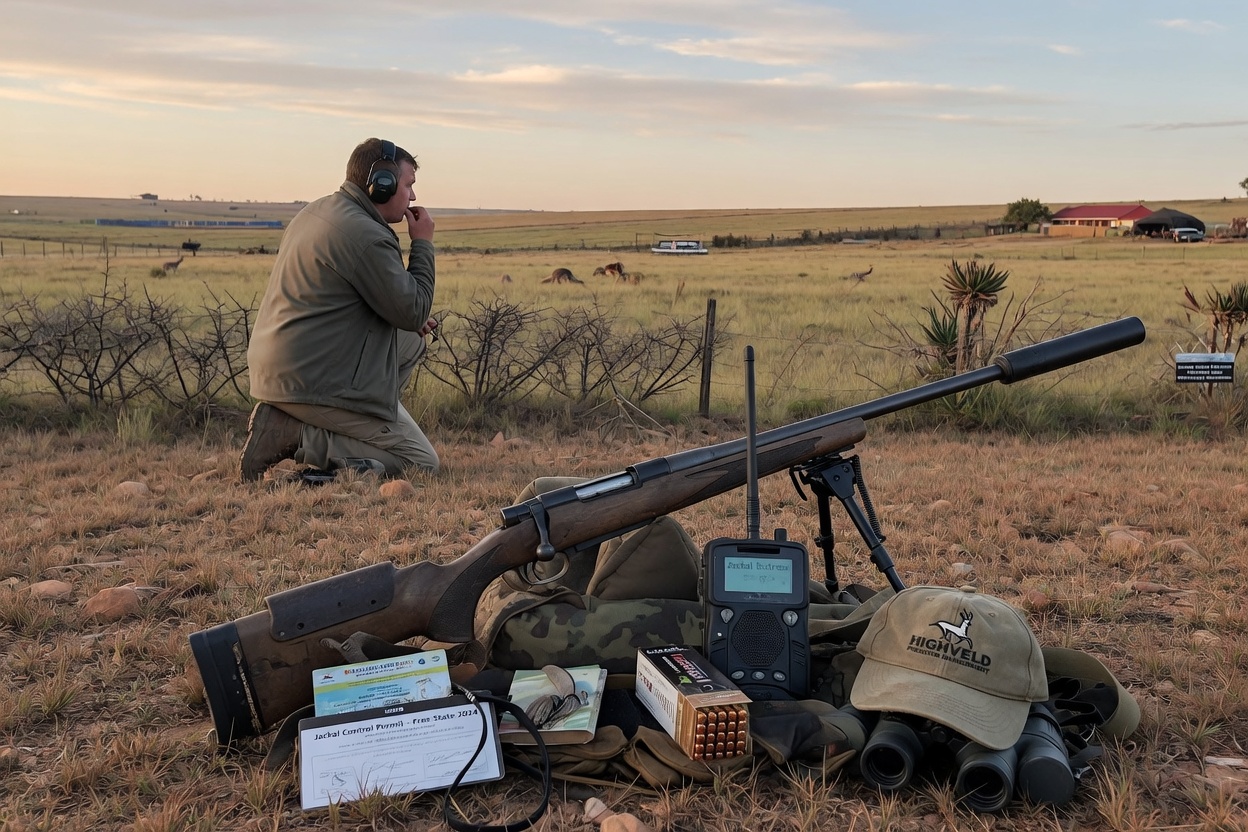
The vast, open grasslands of South Africa's Highveld stretch across parts of Gauteng, the Free State, North West, and Mpumalanga, forming some of the country's most productive farming country. These landscapes of maize fields, pastures, and rolling hills support livestock operations that feed the nation, yet they also harbor a persistent challenge: the black-backed jackal. For hunters who value both the thrill of the chase and the chance to contribute meaningfully to rural livelihoods, legal jackal control hunts on Highveld farms represent a unique and rewarding opportunity.
Black-backed jackals are among the most adaptable predators on the continent. Intelligent, opportunistic, and highly vocal, they thrive in farming environments where natural checks on their numbers are limited. Farmers across the Highveld regularly report losses of lambs, kids, and occasionally calves to these canids. Agricultural studies and provincial reports have long documented that jackals, alongside caracals, account for a significant share of small-stock mortalities, translating into real economic pressure on family farms and commercial operations alike. While jackals do help keep rodent numbers in check, their populations can expand rapidly in the absence of larger predators, creating an imbalance that control hunting helps address.
Participating in these hunts is not about indiscriminate shooting. It is about legal, ethical, and effective predator management conducted with landowner permission and in accordance with provincial regulations. In most Highveld provinces, black-backed jackals may be hunted throughout the year when they are causing damage or when the landowner requests control. Night hunting with artificial lights and electronic callers is commonly permitted for jackals, but hunters must obtain the necessary provincial permits and always carry written permission from the property owner. Regulations differ slightly between provinces, so the responsible first step is to contact the relevant nature conservation authority and confirm current requirements for lights, callers, and night shooting. Licensed firearms, valid hunting permits where applicable, and adherence to the Firearms Control Act remain non-negotiable.
I have spent many nights on Highveld farms listening to jackals calling across the frost or the late-summer grass. Those experiences taught me that success begins with relationships. Farmers are often grateful for competent, respectful hunters who treat their land and livestock with care. Approach landowners through established hunting associations, farmers' unions, or personal networks. Offer to hunt specific problem areas, share your results afterward, and leave the property better than you found it. This builds long-term access that benefits everyone.
The most productive method remains nocturnal calling combined with careful identification and precise shooting. Set up on a rise or use a vehicle as a mobile platform. Electronic callers playing territorial howls, pair yips, or prey-distress sounds will draw jackals from surprising distances. Once an animal appears, confirm it is a jackal before the shot. Eyeshine alone is never enough. Modern thermal imagers and quality night-vision optics have made identification far more reliable than older spotlight-only methods, reducing the risk of mistakes. A well-placed shot from a .223 Remington, .22-250, or similar flat-shooting cartridge through the heart-lung area produces a quick, humane kill. Practice at realistic ranges and under low-light conditions so that when the moment comes, you are ready.
Daytime opportunities exist as well. Glassing open country at first and last light or using callers from a concealed position can produce results, especially in winter when cover is reduced. However, jackals are wary and most active after dark, so night work remains the cornerstone of effective control.
Equipment should be chosen for reliability and safety. A scoped rifle zeroed for the ranges you expect, a powerful but legal spotlight or thermal unit, a quality electronic caller with a remote, and clothing that matches the Highveld palette of gold winter grass or green summer growth will serve you well. Always know your backstop. Farmhouses, livestock camps, and public roads are never acceptable directions of fire. Communicate your plans with the farmer so that workers and family members stay clear of hunting areas.
Ethics sit at the heart of every control hunt. Even though the goal is population management rather than a trophy, the animal still deserves a clean death and respectful treatment. Recover what you can. Some hunters keep the pelts; others simply ensure the carcass is removed from grazing areas. Avoid shooting near livestock or in a manner that could cause unnecessary stress to farm animals. These hunts support conservation by helping maintain viable farming operations that in turn preserve habitat for a wide range of other species. Over-hunting a single property is rarely necessary because jackals recolonize quickly; work with the landowner to determine the right level of effort.
Practical considerations make the difference between a frustrating night and a successful one. Scout for tracks, scat, and listening posts during daylight. Hunt around lambing or calving periods when jackals are most active around livestock. Cooler, still nights often produce better calling responses than windy or rainy ones. After the hunt, debrief with the farmer. That conversation often leads to the next invitation.
Legal jackal control hunts on Highveld farms offer something increasingly rare: purposeful hunting that directly helps people who live and work on the land. They demand skill, patience, and a commitment to doing things the right way. If you have never tried predator control work, start by connecting with local hunting clubs or reputable outfitters who already have farm relationships. Study the regulations, practice your shooting, and approach every outing with professionalism.
The Highveld nights still echo with jackal howls. For hunters willing to operate legally, ethically, and in partnership with farmers, those howls represent both a challenge and an invitation. Get out there, do it right, and you will discover one of the most satisfying forms of hunting South Africa has to offer. Share your own Highveld jackal stories and tips with fellow hunters. Responsible participation keeps these opportunities open for the next generation.