Hunting the open sands of southern Africa brings you face to face with one of the continent's most striking antelopes, the gemsbok. These desert-adapted animals leave clear clues in the sand if you know how to read them. For beginners, learning to identify gemsbok tracks, also called spoor, is one of the most useful skills you can develop. It turns a random walk into a purposeful hunt and deepens your connection to the land and the animal. This guide covers everything from basic track shape to aging prints, distinguishing similar species, and applying the knowledge ethically in the field.
The gemsbok, scientifically known as Oryx gazella, thrives in arid regions of Namibia, Botswana, and South Africa. Adults stand about 1.2 meters at the shoulder and can weigh 180 to 240 kilograms. Their long, spear-like horns and bold black-and-white face markings make them instantly recognizable, yet their tracks tell a quieter story. Gemsbok obtain most of their water from vegetation and can survive long periods without drinking. This means their movements often follow food sources and shade rather than obvious waterholes. Populations remain stable and are listed as Least Concern by the IUCN, largely because well-managed hunting concessions generate funds for habitat protection and anti-poaching work. Understanding their tracks therefore supports both successful hunts and long-term conservation.
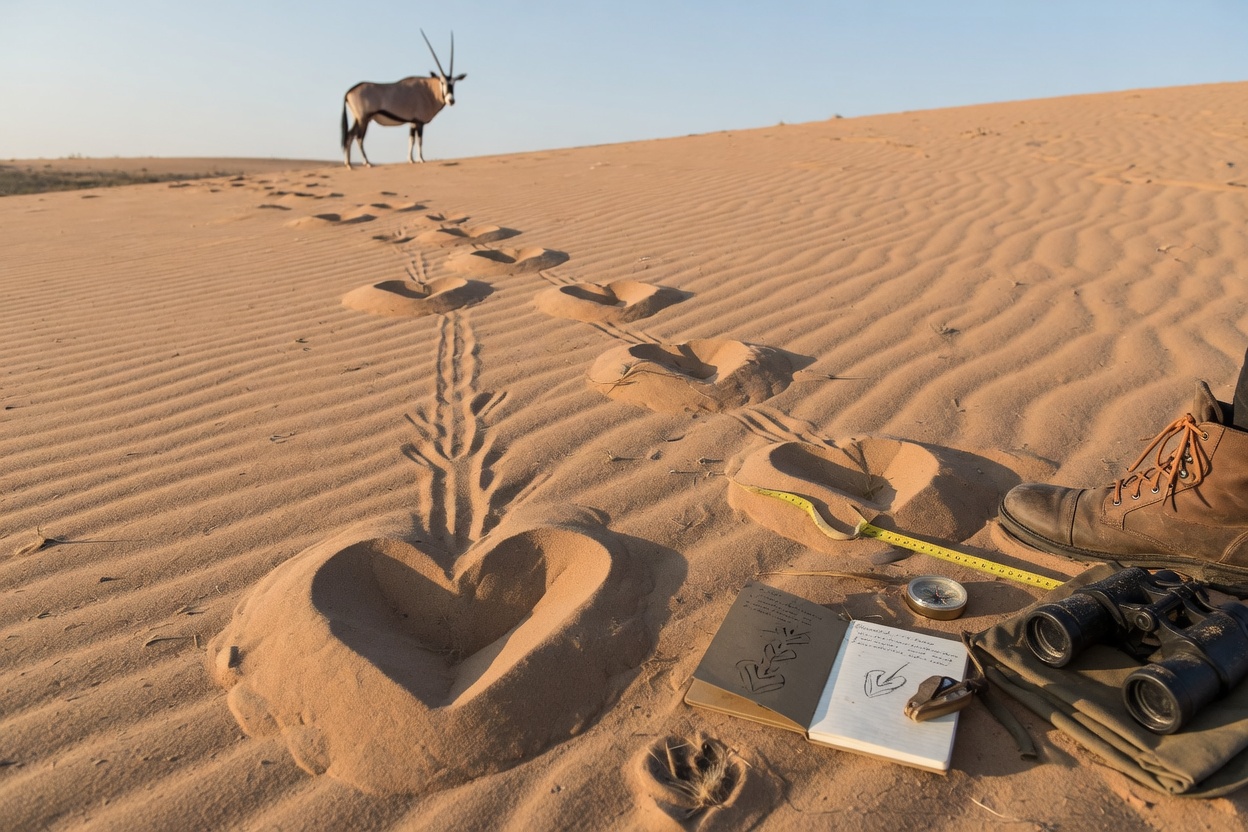
A gemsbok track is a classic cloven-hoof print. Each foot leaves two pointed impressions that together form an elongated, slightly heart-shaped outline. Adult tracks typically measure 9 to 11 centimeters long and 7 to 9 centimeters wide. The two halves of the hoof sit close together, giving a neat, compact look compared with more splayed species. The pointed tips always face the direction of travel. Sand or loose soil is pushed backward from the rear of the print, confirming the heading. Front tracks are a little larger and more spread than hind tracks because the front legs carry more weight. A normal walking stride measures roughly 70 to 90 centimeters from one front track to the next front track of the same side.
Sand type changes how much detail you see. Fine, dry Kalahari or Namib sand often holds deep, crisp impressions that show the exact outline of each hoof. Wind can erase those details within hours, so the best time to start tracking is just after sunrise on a still morning. Hard-packed or slightly damp sand produces shallower but longer-lasting prints. After rare rains the sand can act like wet plaster, capturing almost perfect casts. To judge age, examine the edges. Sharp, well-defined rims mean the track is fresh, often less than a few hours old. Rounded, wind-smoothed edges or sand that has begun to fill the print indicate older sign. In hot conditions a very recent track may still feel cooler than the surrounding surface or show grains that have not yet settled.
Beginners frequently mix gemsbok tracks with those of other animals sharing the same range. Springbok prints are much smaller, usually 5 to 6 centimeters long, and more rounded. Kudu tracks can approach similar length but tend to be narrower and more elongated. Eland tracks are larger and broader, almost cattle-like. Zebra leave a single, uncloven rounded hoof. Domestic goats or sheep produce smaller, more pointed prints that often appear in larger groups. Context helps: gemsbok usually travel in small family groups or pairs, and their tracks appear in more open, sandy flats rather than thick bush. Always look for supporting signs rather than relying on a single print.
Full spoor reading goes beyond footprints. Gemsbok droppings consist of small oval pellets, often deposited in loose piles. Fresh dung is dark, moist, and slightly shiny. Feeding sign includes neatly nipped grass or browsed shrubs with characteristic bite heights. Bedding spots in sand show a body-sized depression, sometimes with hair or a few pellets nearby. Combining these clues with the tracks lets you estimate the animal's size, sex (larger tracks and wider stride often indicate a bull), direction, and how recently it passed. A cluster of fresh tracks, dung, and feeding sign usually means the animal is still nearby.
Practical field technique starts with patience. Move slowly, scan several meters ahead rather than staring at your feet, and use low-angle sunlight to make prints stand out. Photograph every clear track with a known object such as a knife or coin for later comparison. If the trail disappears, stop, mark the last print, and search in widening circles. Watch the wind so your scent does not blow toward the animal. Carry plenty of water and hunt with an experienced professional hunter when in Africa; they know local conditions and legal requirements. Common beginner mistakes include rushing, ignoring wind direction, and assuming every large cloven print belongs to a gemsbok. Practice on known animals first, even if that means studying cattle or horses at home to train your eye.
I still remember following a set of gemsbok tracks across red Kalahari sand at first light. The prints were so sharp I could see individual hoof ridges. The trail looped, paused at a patch of succulent plants, then led over a low dune. That morning taught me that tracking is conversation with the landscape. The animal had been there only minutes earlier, and the sand recorded every decision it made. Moments like that remind us why we hunt: not merely to take an animal, but to participate fully in the wild system that produced it.
Ethical hunting remains central. Fair-chase principles, taking only mature animals, and using as much of the harvest as possible honor both the gemsbok and the habitat. License fees and trophy fees paid by hunters directly fund community projects and wildlife protection across southern Africa. Choose outfitters who demonstrate genuine commitment to sustainability rather than high-volume shooting.
Mastering gemsbok tracks in sand takes time in the field, but every hour spent observing pays off. Start with photographs and local practice, then apply the skills on your next hunt. The desert will begin to speak a language you can understand. Share your own tracking experiences in the comments, ask questions, and consider joining a guided safari with a conservation-minded operator. The more hunters who learn to read spoor properly, the better we all become at protecting the places we love to hunt. Get out there, stay ethical, and let the sand tell its story.