The Cape buffalo stands as one of Africa's most formidable dangerous game animals, earning nicknames like Black Death and Widow Maker for good reason. Weighing up to a ton with hooked horns capable of tossing a grown man like a rag doll, these animals combine unpredictable temperament with incredible toughness. A buffalo safari delivers unmatched excitement, yet it demands unwavering adherence to safety protocols. Lapses have claimed lives of both clients and professional hunters over the decades. This post outlines proven dangerous game safety protocols drawn from field experience, PHASA guidelines, and lessons from recent hunts across southern and east Africa.
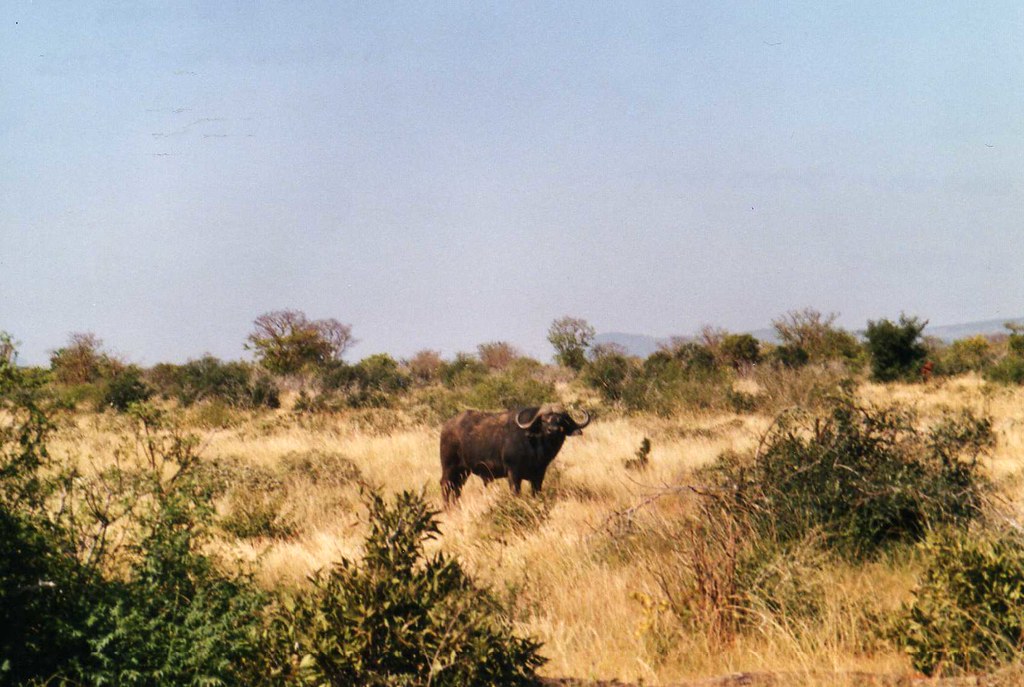
Cape buffalo inhabit a range of habitats from open savanna to dense riverine thickets and mopane scrub. Their danger stems from several factors. They possess thick hides, heavy bone, and a determination that allows them to absorb multiple well-placed shots and still close the distance. A charge can cover 30 to 40 yards in seconds at speeds approaching 35 miles per hour. Unlike many species that flee when wounded, a buffalo frequently circles back or lies in wait, turning the follow-up into the most hazardous phase of the hunt. Historical records and outfitter reports consistently show buffalo involved in a high percentage of serious incidents among the Big Five. Recent years have seen improved data collection through hunting associations, highlighting that most accidents occur during close-range follow-ups in thick cover rather than the initial approach.
Preparation begins months before departure. Choose an outfitter with a documented history of successful and safe buffalo hunts. Speak directly with the professional hunter who will guide you and confirm their experience level with the species. Hundreds of buffalo taken under their belt provides far more value than a flashy website. Your rifle must meet or exceed legal minimums, typically the .375 H&H Magnum in most countries, though many seasoned hunters and PHs prefer .416 Rigby, .458 Lott or equivalent for greater stopping power. Practice extensively from field positions, including shooting sticks and offhand, until you can deliver accurate shots under simulated stress. Premium ammunition is non-negotiable. Many teams use a controlled-expansion bullet for the first shot followed immediately by solids. Confirm your load with the PH well in advance.
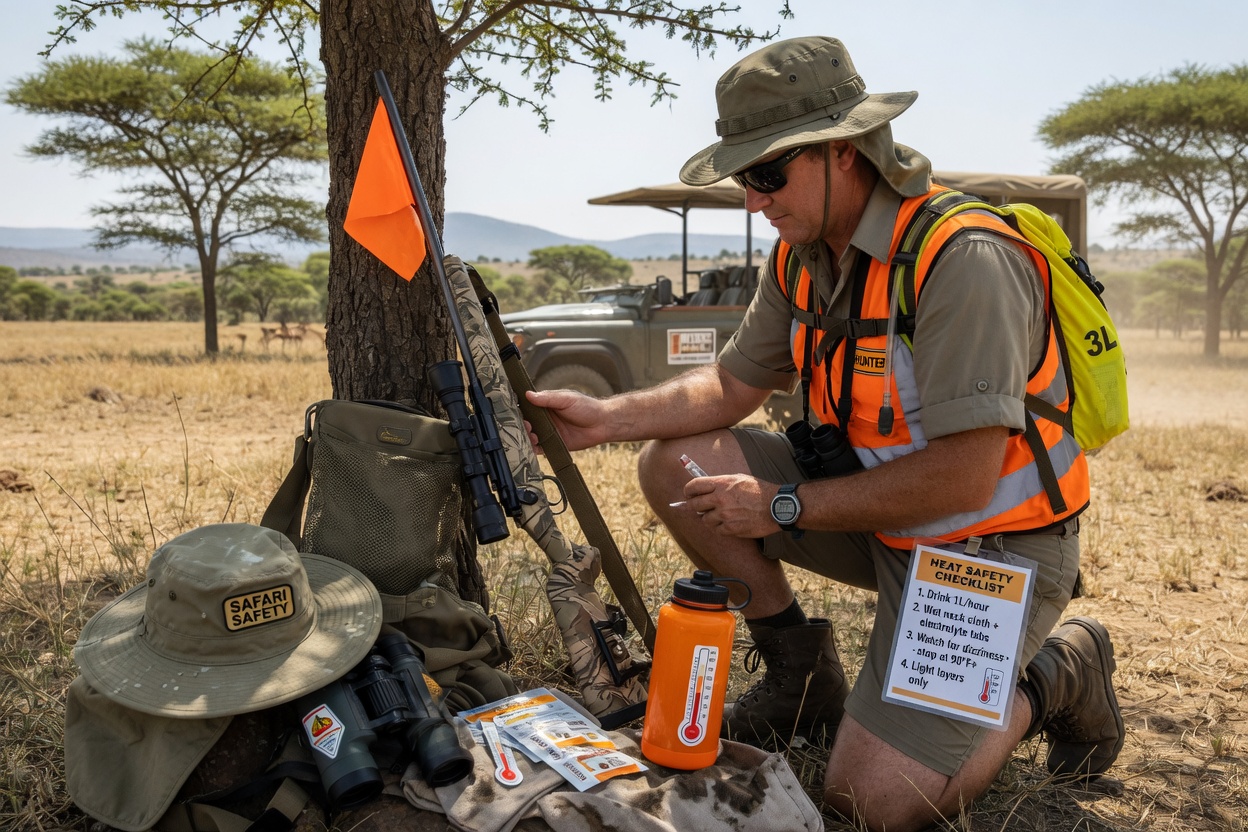
Physical conditioning matters more than many realize. Buffalo hunts frequently involve long hours of walking in heat, sometimes carrying a heavy double rifle through thorn and sand. Build cardiovascular endurance and core strength. Complete a full medical evaluation and secure comprehensive travel insurance that specifically covers hunting accidents and emergency evacuation. On arrival, participate fully in the safety briefing. Understand the chain of command: the PH directs every movement, trackers provide eyes and ears, and you follow instructions without question or delay.
During the hunt itself, positioning and awareness form the core of safety. Remain directly behind the PH at all times with your rifle slung or carried in a ready but safe condition. Safety stays on until the PH indicates otherwise. Wind direction is critical because buffalo possess an excellent sense of smell. In thick jess or reed beds, visibility often drops to a few yards, increasing the chance of a surprise encounter. The team moves slowly, using binoculars and listening for telltale sounds of movement or alarm. Never push ahead or separate from the group. If a herd is located, the PH evaluates for a mature bull and a clear, ethical shot opportunity. Shooting into a mixed group without a specific animal identified violates both safety and conservation principles.
When the moment arrives, shot placement decides the outcome. The preferred first shot remains a broadside or slight quartering-away heart-lung hit, aiming just behind the shoulder crease at mid-body height. Buffalo vitals sit lower than many hunters expect. A high shot often results in a wounded animal that becomes exponentially more dangerous. Fire, immediately work the action, and stay on the animal. The PH typically fires a backup shot in the same instant. Do not celebrate or lower the rifle. Buffalo have been known to drop, appear dead, then rise and charge with lethal intent.
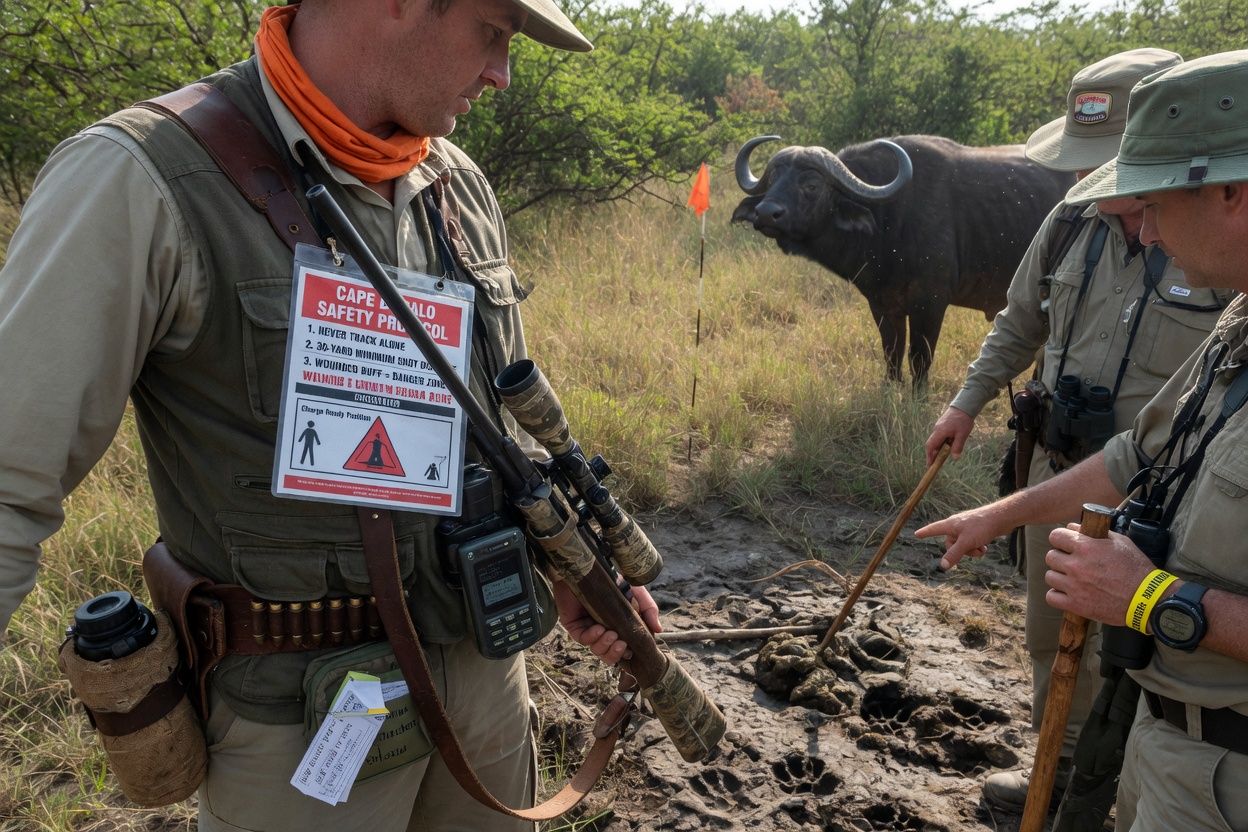
The follow-up of a wounded buffalo represents the highest-risk period. Standard protocol calls for waiting 15 to 30 minutes after the shot unless the hit is obviously fatal or the animal is visible and down. Mark the exact location of the shot and last sighting. The tracker then leads on the blood trail with the PH immediately behind and the client in a supporting position, rifle ready. Multiple rifles cover different angles. Proceed at a crawl in thick cover. Look for blood color and volume, tracks, and disturbed vegetation. Bright frothy blood suggests a lung hit; dark blood may indicate a liver or muscle wound. Listen constantly for breathing, groaning, or the sound of an animal shifting position.
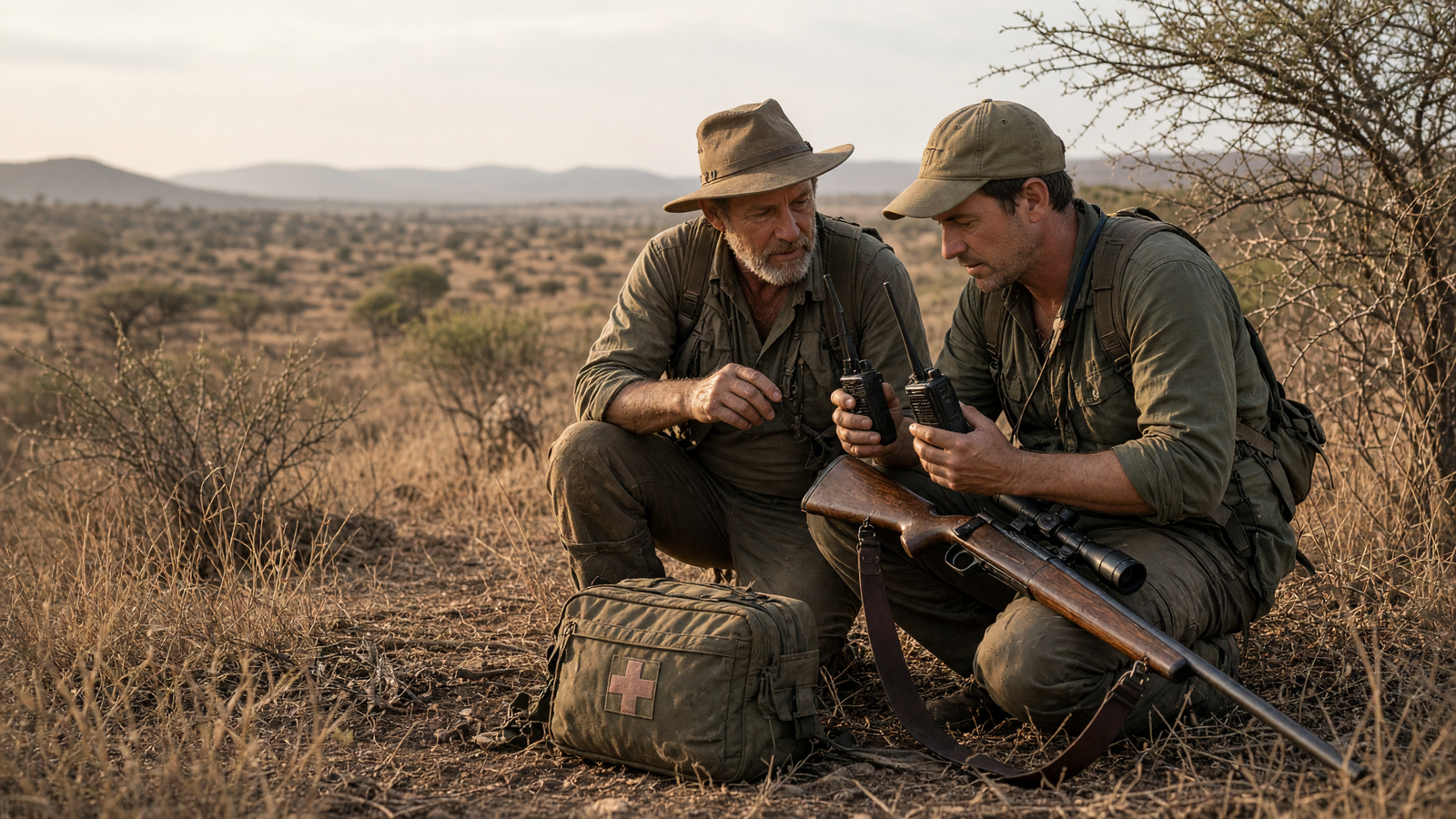
If the buffalo is located still alive, the PH decides the finishing shot, often from a position of cover. In the event of a charge, stand your ground. Running almost always results in being caught. The designated shooter, usually the PH, aims for the center of the chest or, at very close range, the brain shot between the bosses or through the nose. Clients must remain calm and ready to fire if instructed. Communication stays whispered or uses pre-arranged hand signals. Some modern teams now employ compact radios or in-ear devices, a recent improvement that enhances coordination without adding noise.
Emergency response planning has advanced significantly. Every team should carry a dedicated trauma kit containing tourniquets, hemostatic agents, chest seals, and pressure dressings. These items have saved lives in recent incidents involving gorings. Know the location of the nearest capable medical facility and the evacuation procedure, whether by vehicle or air. Satellite communicators have become standard on remote concessions, allowing faster contact with flying doctor services. If an injury occurs, control hemorrhage first, then stabilize and extract. Practice these steps in camp so reactions become automatic.
Ethical hunting and conservation remain inseparable from safety. A well-managed buffalo hunt generates substantial revenue that funds anti-poaching units, community programs, and habitat protection. Select mature bulls past their breeding prime whenever possible. Practice fair chase by avoiding vehicles for the actual stalk and respecting local regulations. Report any observed unethical conduct. The buffalo you pursue deserves respect; treating the hunt as a privilege rather than a conquest reinforces the entire system that keeps these animals abundant.
Buffalo safaris reward those who prepare thoroughly and execute protocols without compromise. The combination of physical challenge, mental focus, and raw power of the animal creates memories that last a lifetime, provided everyone returns unharmed. Review these guidelines with your outfitter, practice your shooting, and commit to following the PH's lead. Your safety, the safety of the team, and the future of buffalo hunting depend on it.
Share this information with hunting partners planning their first or next African adventure. If you have additional protocols or experiences from the field, add them in the comments so the community can continue learning. Hunt ethically, stay vigilant, and come home with stories worth telling.