Ogilby's Duiker Hunting
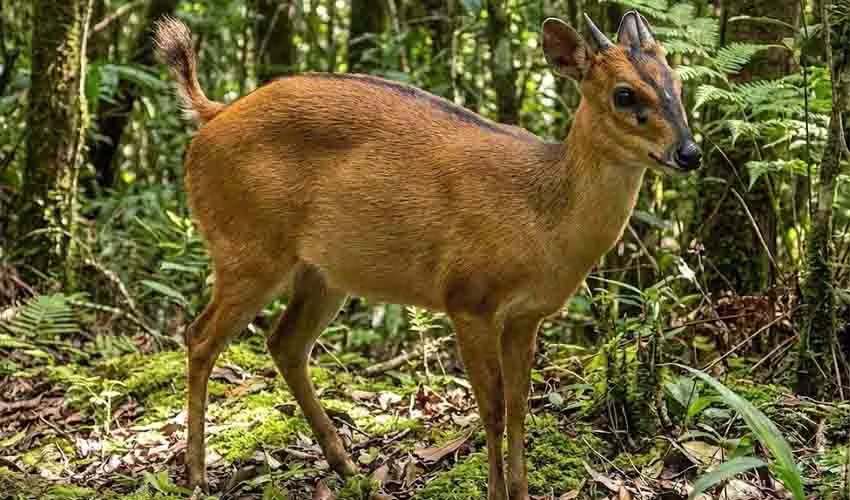
Cephalophus ogilbyi
Ogilby's Duiker is a striking forest antelope found in the rainforests of West Africa, offering hunters a challenging and rewarding pursuit in dense cover. Adults typically measure 20 to 22 inches at the shoulder and weigh 30 to 44 pounds, with a sleek reddish-orange to chestnut coat marked by a prominent black stripe along the back and a paler underside. Males carry short, sharp horns averaging 3 to 4 inches, while both sexes have a compact, agile build suited to quick dashes through thick vegetation. These duikers occupy lowland tropical forests from Sierra Leone and Liberia through Ivory Coast to Ghana, favoring areas with dense undergrowth, fallen fruit, and ample browse. They are largely solitary or found in pairs, remaining secretive and most active at dawn, dusk, and night. Their diet consists of fruits, leaves, and seeds, and they rely on keen senses and well-used trails to navigate their habitat while avoiding predators. Hunters value Ogilby's Duiker for its wariness and the skill required to locate it in heavy forest, often through still-hunting or following tracks and feeding signs. The compact horns make an attractive trophy, and the species tests a hunter's patience and woodsmanship. Populations face pressure from habitat loss and hunting, with the IUCN listing the species as Vulnerable, so responsible, legal harvest in managed areas supports conservation while providing a memorable forest hunt.
Hunt facts
Where to Find Ogilby's Duiker
Ogilby's Duiker lives in dense tropical rainforests of West and Central Africa, mainly southern Cameroon, Gabon, Equatorial Guinea, and adjacent parts of Nigeria. These shy antelopes favor primary and secondary lowland forests with thick undergrowth, high humidity, and a closed canopy that offers cover.
Cameroon and Gabon offer the most practical hunting opportunities through established forest concessions where permits can be obtained. Access in Equatorial Guinea is more limited. The dry season from November through March provides the best conditions, as trails stay firmer and animals concentrate near water; the rains turn the forest floor into mud and restrict movement.
Expect challenging terrain of tangled vines, swampy patches, and limited visibility under the canopy. Locate them by following fresh tracks and droppings along game trails, listening for their sharp whistling calls at dawn and dusk, and using experienced local trackers who know fruiting trees they browse. They move mostly alone or in pairs and freeze or slip away at the first hint of danger, so slow, quiet approaches work best.
Why Hunt Ogilby's Duiker
People hunt Ogilby's Duiker because it lives in thick African forests. This shy antelope has a reddish coat that stands out to hunters. It is special due to its small size and secretive ways. Finding it takes real skill. The dense jungle makes the hunt hard and exciting. You must move quietly and wait with patience. The animal is quick to run. This challenge is fun for many hunters. Some hunt it for the meat it provides. Others enjoy the sport of tracking it. Legal hunts can help local people earn money. They also keep animal numbers in check. Always follow the rules in each area.
Ogilby's Duiker Hunting Tips
Hunting Ogilby's duiker occurs in dense West African rainforests where these shy antelopes stay hidden. Still-hunting or slow stalking with local trackers who know feeding spots near fruiting trees works best. Expect close shots under 40 yards in thick cover.
Use a lightweight rifle such as a . 243 Winchester or 6. 5 Creedmoor, or a 12-gauge shotgun with slugs. Camouflage, quiet boots, and a flashlight help in low light.
Aim just behind the shoulder into the heart-lung area for a clean kill on this small animal.
Search for tiny tracks, droppings, and browse signs. Always move into the wind, pause often, and scan shadows with binoculars.
Dawn and dusk in the dry season give the highest activity and slightly better visibility. Follow all local seasons and laws.
Avoid rushing, ignoring wind direction, or hunting without permits. Watch for snakes and larger animals, hunt with a partner, and carry a GPS.
Featured Outfitters for Ogilby's Duiker
View all


Plan Your Ogilby's Duiker Hunt
Submit a free enquiry and we'll match you with outfitters who hunt Ogilby's Duiker in your region.
Sign Up to Enquire African Civet
 African Wildcat
 Baboon
 Bat-Eared Fox
 Bay Duiker
 Black-Fronted Duiker