White-Bellied Duiker Hunting
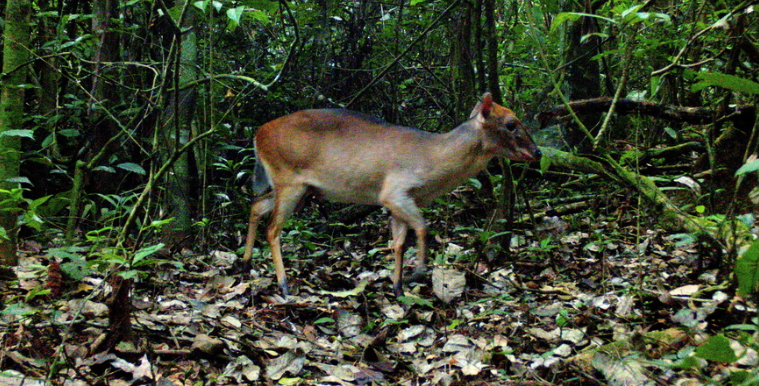
Cephalophus leucogaster
The White-Bellied Duiker is a compact forest antelope that rewards patient hunters with its striking looks and demanding pursuit in Central Africa's rainforests. Adults stand 45 to 50 centimeters at the shoulder and weigh 15 to 20 kilograms. The coat is a rich chestnut-red on the back and flanks, set off by a clean white belly, chest, and inner legs. Both sexes carry short, straight horns of 5 to 10 centimeters, and a dark forehead tuft adds to the distinctive profile. These duikers live in the dense understory of primary and secondary tropical forests, from southern Cameroon and Gabon through the Congo Basin into the Democratic Republic of the Congo. They are largely solitary and most active at dawn, dusk, and night, feeding on fallen fruit, leaves, and shoots while remaining hidden in thick cover. Hunters value the species for its attractive pelt and modest but well-formed horns. The animal’s small size and preference for almost impenetrable vegetation make it a true test of tracking skill, often requiring close-range shots in low light or the help of experienced local trackers and dogs. Success depends on quiet movement, knowledge of fruiting trees, and respect for the dense habitat. The White-Bellied Duiker is currently listed as Least Concern, yet local numbers can decline where habitat is cleared or hunting is unregulated. Legal, licensed hunting that follows country-specific quotas and seasons helps support conservation of the forests these animals need.
Hunt facts
Where to Find White-Bellied Duiker
White-bellied duikers inhabit the dense equatorial rainforests of Central Africa, mainly in Cameroon, Gabon, Equatorial Guinea, the Republic of the Congo and western Democratic Republic of the Congo. They favor lowland tropical forest with thick understory, fruiting trees and nearby water.
Legal hunting opportunities are limited to licensed concessions in Cameroon and Gabon. Permits and quotas must be obtained in advance, as regulations change and some populations receive extra protection.
Drier months from June to September improve trail access, though the animals remain active year-round. Expect hot, humid jungle with limited visibility, muddy ground and occasional swamps.
Look for small cloven tracks, pellet dung and browse marks on low vegetation. These secretive duikers move most at dawn and dusk near fruiting trees or forest streams. Local trackers greatly increase success in the dense cover. Always confirm current hunting laws before planning a trip.
Why Hunt White-Bellied Duiker
Hunters pursue the White-Bellied Duiker for its distinctive trophy appeal, featuring a rich reddish-brown coat with a striking white belly and compact horns that make an exceptional display piece. The hunt ranks among the most challenging and exciting due to the animal's secretive nature in impenetrable rainforest habitats, demanding expert tracking skills, patience, and close-range encounters that get the heart racing.
The meat is of superb quality, tender and flavorful, often enjoyed in local culinary traditions. Culturally, this species holds significance in Central African communities where hunting forms part of heritage and subsistence. Through regulated hunting, funds support conservation efforts, protecting habitats and combating illegal poaching.
This species offers unique experiences like immersing in dense equatorial forests, spotting other rare wildlife, and achieving a truly wild, off-the-beaten-path adventure unlike open-savanna hunts.
White-Bellied Duiker Hunting Tips
Hunting white-bellied duikers requires stealth in dense Central African rainforests. The best methods are careful stalking and still-hunting near fruiting trees or waterholes, as these shy antelope stay in thick cover. They are most active at dawn and dusk, making those the ideal times, particularly during the dry season when movement is easier to detect. A lightweight rifle in calibers such as . 243 Winchester or . 270 works well with a low-power scope or iron sights for typical close-range shots. Shotguns with slugs are suitable alternatives in heavy brush. Aim shots just behind the shoulder to hit the heart and lungs for a quick, humane kill. Track by searching for small cloven prints, droppings, and feeding signs on low plants. Approach slowly into the wind, stop often to listen, and use binoculars. Common mistakes to avoid include talking, wearing perfume, rushing the shot, and hunting without proper identification. Always obtain necessary licenses and follow regulations. For safety, watch for elephants and other hazards, carry navigation tools and a first aid kit, dress in earth tones with insect repellent, and hunt with a companion when possible.
Featured Outfitters for White-Bellied Duiker
View all


Plan Your White-Bellied Duiker Hunt
Submit a free enquiry and we'll match you with outfitters who hunt White-Bellied Duiker in your region.
Sign Up to Enquire African Civet
 African Wildcat
 Baboon
 Bat-Eared Fox
 Bay Duiker
 Black-Fronted Duiker